Mnuchin is Right: the Fed’s Zombie Feast Must End

It seems counterintuitive to shut emergency financial market support programs in the middle of a pandemic and recession. But Treasury boss Steve Mnuchin’s move to force (there’s no other word for it) the Federal Reserve to let its most underused, and economically damaging, special purpose vehicles (SPVs) lapse as scheduled on December 31 is the right thing to do. Indeed, it should have been done sooner, before the programs prompted the most lamentable, economically distorting feeding frenzy for credit zombies and leveraged lenders the world has ever seen.

Mnuchin broke the news to Fed boss Jerome Powell on Thursday, sending markets fluttering. Financial reporters wrung their hands. The usually sensible FT moaned:

The move by Mr Mnuchin jeopardised a very effective partnership with Mr Powell that was crucial to securing a hefty US policy response to the coronavirus crisis early on. The central bank made no secret of the fact that it wanted to preserve the credit facilities being axed by the Treasury secretary as a key weapon in its arsenal to keep markets healthy during the pandemic.

Mnuchin notes that the five SPVs that Treasury wants to shut down (four others, which back short-term lending markets, will be renewed for another 90 days) succeeded. Oddly, they did so despite barely being used. The mere fact that the Fed said it would buy corporate bonds and bond ETFs juiced the lending markets to the point where they shoveled money at even the dodgiest credits. Not bad for jawboning. The Fed bought about $25 billion of securities under the programs (which had a total capacity of $2 trillion). This is a rounding error compared with the other QE programs that have swelled the Fed’s balance sheet to over $7 trillion.
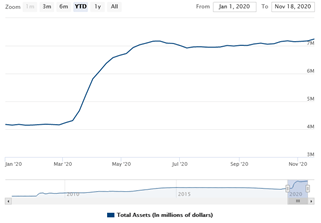
Fed Balance Sheet

Hot air, even in finance, rises. The Fed’s hot air caused the markets to abandon any notion of credit discrimination. Cruise lines and airlines borrowed billions. Every zombie with a working phone could get an investment bank to float its bonds.

Wolf Richter summarizes Mnuchin’s 12 reasons for pulling the plug here. Among the list of ostensible successes are the breathtaking volumes of junk and investment grade corporate bonds, municipal debt and asset backeds, issued since March. The cost of funding meanwhile became uncoupled from any reasonable credit fundamentals. Mnuchin notes that the spread on investment grade corporates has fallen from a peak of 4.06 percent to 1.40 percent, and on junk bonds from 10.78 percent to 4.94 percent.

So, the stated reason for pulling the plug is that jawboning worked, even if it was not backed up with actual purchases, and the SPVs have, according to Mnuchin, “clearly achieved their objective.”

That conclusion is only true if the programs were meant to completely undermine the process for sensible allocation of capital in our economy. The markets are not healthy. They are a farce. The government has been childishly reluctant to allow capitalism to work and to let untenable businesses go bankrupt so that resources can be invested productively. Investment-grade companies borrowing at under 2 percent and junk companies at under 4 percent is not a sign of victory. It is a disaster. If markets ever “normalize” and credit risk once again becomes a factor, the amount of refinancings required by the walking dead will probably require – yup – more government intervention to keep the junk windows open.

Bear in mind, this farce is mainly a bonanza for the economy’s dead weight. Normal financing is available for viable companies. As Mnuchin wrote on Thursday, “Banks have the lending capacity to meet the borrowing needs of their corporate, municipal and nonprofit clients.” The volume of commercial and industrial lending is down, mainly due to weaker demand, according the to Fed’s most recent survey of bank loan officers. But banks are still reasonably well capitalized and able to lend.

So Mnuchin’s move is a welcome one, even if it only keeps the Fed from throwing more gasoline on the credit market conflagration. Best outcome for the economy? The credit markets really freak out this week, bond prices drop like stones and borrowing rates rise to reasonable levels. That would be bloody, but necessary. If it happens, and the markets start to howl, the Greenspan Putters at the Fed will be revving their helicopters. Here’s hoping that Mnuchin keeps his nerve.

The Fed’s Credit Head Fake Imperils Yield Curve Policy Prospects

The Fed has still not acted on its promise in February to purchase essentially unlimited amounts of investment grade and junk corporate debt and ETFs. While a yield chasing frenzy has allowed marginally investment grade issuers – including Walking Dead extras Carnival and Boeing – to raise stonking amounts of debt without the central bank’s help, the Fed risks losing credibility. Given its hopes to manage its balance sheet bloat through a yield curve control (YCC) policy, its timing couldn’t be worse.

The Fed’s empty jawboning has not gone unnoticed. On Friday, Bank of America credit analysts wrote:

Note to Fed: a lot of investors (including non-credit ones) have bought IG corporate bonds the past two months. . . on the expectation they can sell to you. So would be helpful if you soon began buying broadly and in size. (H/T Grant’s Almost Daily)

On April 23, Wolf Richter wrote:

So over the past four weeks, the Fed has not done any of the things with these SPVs and Primary Dealers that the markets were raving about it would do. It didn’t buy junk bonds, it didn’t buy ETFs, it didn’t buy stocks, it didn’t buy old bicycles. But Wall Street sure loved raving about it.

The situation hadn’t changed as of last week’s Fed balance sheet report.

The Fed’s credibility, always crucial, is particularly important now, with central bank grandees considering using a YCC policy to control rates without further ballooning its balance sheet. In essence, this involves telling the market that it will buy Treasuries at a given price. No one sells lower than that, knowing they can sell to the Fed, so rates stay at the target level, even if the Fed doesn’t actually buy much. But for that to work, as it did during World War II, the market has to believe the Fed will support the peg.

Hence the need for credibility, which the Fed is now frittering away.

Of Falling Knives and Vicious Circles: Will the Corona Crisis Spread Like the 2008 Crash?

Catching a falling knife? Check. Rushing the exits? Yup. Vicious circle? Yeah, that one too. Market clichés last heard during the 2008 Financial Crisis are back in vogue among the financial commentariat. But there are important differences between that disaster and the market meltdown unfolding this week. It’s unlikely the Corona Crisis will metastasize in the same way.

The 2008 crisis had several novel characteristics. A significant driver was incorrect risk management assumptions about the correlations among assets. When mortgages proved to be more correlated than models assumed, mortgage-backed securities bombed. More broadly, entire bank business models based on the assumption that diversification was an unchallengeable law became fountains of red ink when different types of assets began declining in lockstep.

Two related factors meant to improve risk management ended up acting as vectors of contagion, turning a housing problem into a disaster for the bond and equity markets, too. The first were regulatory capital rules, which require banks to set aside more capital against high-risk assets than they set aside against safer ones. The second factor is the market practice of requiring a firm to stump up more collateral when a trading position declines in value.

These all sound sensible. But if the assets becoming riskier (mortgage-backed bonds in 2008) cannot be sold easily, banks have to get the money to pay their capital and collateral requirements by selling other types of assets, like stocks, Treasuries and corporate bonds. Banks started pouring these assets into the markets in 2008, driving down prices on the securities, some of which they retained in their portfolios, triggering the need for yet more capital and collateral, and so on – the archetypical vicious circle.

As these assets fell in price, potential buyers stepped back, not wanting (as the pundits put it) to try to catch a falling knife. So prices of all types of assets plunged further. The result was the worst multi-asset market meltdown since the Great Depression.

The Corona Calamity looks different, so far. If it does become an undifferentiating multi-asset meltdown, it will be because the coronavirus wreaks terrible havoc on the world’s economies, and not because of the types of unanticipated structural links that spread woe in 2008.

There are some positive signs. The negative correlation among asset classes, described by old wives as not keeping all your eggs in the same basket, and finance professors as diversification, appears to be back. The Fed’s abuse of savers through ultra-low rates forced investors to take more risk in the equity markets than they really wanted. Now that stock prices are dropping, “safe haven” assets like Treasuries are in demand. Stocks go down, Treasuries go up – just like the textbooks say should happen.

Regulatory capital rules are still problematic, forcing banks to pony up capital at what appears to be just the wrong times – when the value of their assets are falling. But the Dodd Frank and Basel Committee rules implemented since the Financial Crisis boosted the core capital requirements, so firms are better capitalized from the start. That should give them a bigger margin of error and reduce the chance of igniting a (sorry) run for the exits. And, assuming the Fed’s brain trust doesn’t gut the Volcker Rule, banks are barred from dabbling in ultra-risky proprietary trading, which should help to keep collateral calls to a manageable level.

This means the Corona Crisis could remain an equities problem. Sure, corporations could fail due to supply chain disruptions or falling sales, and so bond investors could take a bath on the squillions they have invested in junk and marginal investment-grade securities. Banks, meanwhile, might have a lot of senior loan write-offs in their future. But equities aren’t principally held by banks, so the regulatory capital and collateral issues should not act as vectors of contagion the way they did during the Financial Crisis.

The Financial Crisis was so pernicious, in part, because it was accelerated and magnified by structural and modeling issues that had never been tested – new product technologies, newish regulatory capital rules, new risk management models. The current meltdown appears to be a refreshingly straightforward catastrophe, with an obvious exogenous trigger and reasonably straight causal lines to be drawn from independent to dependent variables. But I vaguely remember thinking that in early 2008, too….