Mnuchin is Right: the Fed’s Zombie Feast Must End

It seems counterintuitive to shut emergency financial market support programs in the middle of a pandemic and recession. But Treasury boss Steve Mnuchin’s move to force (there’s no other word for it) the Federal Reserve to let its most underused, and economically damaging, special purpose vehicles (SPVs) lapse as scheduled on December 31 is the right thing to do. Indeed, it should have been done sooner, before the programs prompted the most lamentable, economically distorting feeding frenzy for credit zombies and leveraged lenders the world has ever seen.

Mnuchin broke the news to Fed boss Jerome Powell on Thursday, sending markets fluttering. Financial reporters wrung their hands. The usually sensible FT moaned:

The move by Mr Mnuchin jeopardised a very effective partnership with Mr Powell that was crucial to securing a hefty US policy response to the coronavirus crisis early on. The central bank made no secret of the fact that it wanted to preserve the credit facilities being axed by the Treasury secretary as a key weapon in its arsenal to keep markets healthy during the pandemic.

Mnuchin notes that the five SPVs that Treasury wants to shut down (four others, which back short-term lending markets, will be renewed for another 90 days) succeeded. Oddly, they did so despite barely being used. The mere fact that the Fed said it would buy corporate bonds and bond ETFs juiced the lending markets to the point where they shoveled money at even the dodgiest credits. Not bad for jawboning. The Fed bought about $25 billion of securities under the programs (which had a total capacity of $2 trillion). This is a rounding error compared with the other QE programs that have swelled the Fed’s balance sheet to over $7 trillion.
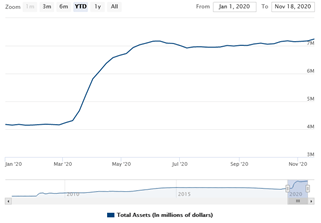
Fed Balance Sheet

Hot air, even in finance, rises. The Fed’s hot air caused the markets to abandon any notion of credit discrimination. Cruise lines and airlines borrowed billions. Every zombie with a working phone could get an investment bank to float its bonds.

Wolf Richter summarizes Mnuchin’s 12 reasons for pulling the plug here. Among the list of ostensible successes are the breathtaking volumes of junk and investment grade corporate bonds, municipal debt and asset backeds, issued since March. The cost of funding meanwhile became uncoupled from any reasonable credit fundamentals. Mnuchin notes that the spread on investment grade corporates has fallen from a peak of 4.06 percent to 1.40 percent, and on junk bonds from 10.78 percent to 4.94 percent.

So, the stated reason for pulling the plug is that jawboning worked, even if it was not backed up with actual purchases, and the SPVs have, according to Mnuchin, “clearly achieved their objective.”

That conclusion is only true if the programs were meant to completely undermine the process for sensible allocation of capital in our economy. The markets are not healthy. They are a farce. The government has been childishly reluctant to allow capitalism to work and to let untenable businesses go bankrupt so that resources can be invested productively. Investment-grade companies borrowing at under 2 percent and junk companies at under 4 percent is not a sign of victory. It is a disaster. If markets ever “normalize” and credit risk once again becomes a factor, the amount of refinancings required by the walking dead will probably require – yup – more government intervention to keep the junk windows open.

Bear in mind, this farce is mainly a bonanza for the economy’s dead weight. Normal financing is available for viable companies. As Mnuchin wrote on Thursday, “Banks have the lending capacity to meet the borrowing needs of their corporate, municipal and nonprofit clients.” The volume of commercial and industrial lending is down, mainly due to weaker demand, according the to Fed’s most recent survey of bank loan officers. But banks are still reasonably well capitalized and able to lend.

So Mnuchin’s move is a welcome one, even if it only keeps the Fed from throwing more gasoline on the credit market conflagration. Best outcome for the economy? The credit markets really freak out this week, bond prices drop like stones and borrowing rates rise to reasonable levels. That would be bloody, but necessary. If it happens, and the markets start to howl, the Greenspan Putters at the Fed will be revving their helicopters. Here’s hoping that Mnuchin keeps his nerve.

The Fed’s Credit Head Fake Imperils Yield Curve Policy Prospects

The Fed has still not acted on its promise in February to purchase essentially unlimited amounts of investment grade and junk corporate debt and ETFs. While a yield chasing frenzy has allowed marginally investment grade issuers – including Walking Dead extras Carnival and Boeing – to raise stonking amounts of debt without the central bank’s help, the Fed risks losing credibility. Given its hopes to manage its balance sheet bloat through a yield curve control (YCC) policy, its timing couldn’t be worse.

The Fed’s empty jawboning has not gone unnoticed. On Friday, Bank of America credit analysts wrote:

Note to Fed: a lot of investors (including non-credit ones) have bought IG corporate bonds the past two months. . . on the expectation they can sell to you. So would be helpful if you soon began buying broadly and in size. (H/T Grant’s Almost Daily)

On April 23, Wolf Richter wrote:

So over the past four weeks, the Fed has not done any of the things with these SPVs and Primary Dealers that the markets were raving about it would do. It didn’t buy junk bonds, it didn’t buy ETFs, it didn’t buy stocks, it didn’t buy old bicycles. But Wall Street sure loved raving about it.

The situation hadn’t changed as of last week’s Fed balance sheet report.

The Fed’s credibility, always crucial, is particularly important now, with central bank grandees considering using a YCC policy to control rates without further ballooning its balance sheet. In essence, this involves telling the market that it will buy Treasuries at a given price. No one sells lower than that, knowing they can sell to the Fed, so rates stay at the target level, even if the Fed doesn’t actually buy much. But for that to work, as it did during World War II, the market has to believe the Fed will support the peg.

Hence the need for credibility, which the Fed is now frittering away.

Fed Brings Knife to Gunfight

The Fed is not only no longer a credible player, it’s actually causing measurable harm. Investors, hoping for something useful to come out of the G-7 conference call this morning, reacted to the central bank’s 50 basis point rate cut by driving the Dow and S&P down 3.5 percent by early afternoon. It would have been wiser for Powell and Friends to keep silent, sequestering their dwindling monetary ammunition for another day, when it might have done some good.

Even stock market investors understand that the Fed is making a category error. The Fed boss may have a hammer, but this crisis isn’t a nail. Specifically, unlike the Global Financial Crisis, when rate cuts helped ease pressure on bank balance sheets, Wall Street just isn’t the problem this time around. The industry’s solipsism makes it hard for bankers, and by extension, the Fed, to understand this. But this time, the trouble stems from events outside their purview. As Wolf Richter put it in a post earlier today, “Disappointed the Fed didn’t print antibodies?”

Worse, the Fed’s move could contribute to trouble in bank-land. In a note out yesterday, Fitch analysts warned that a rate cut could hurt bank profitability. With historic levels of marginal investment-grade debt about to slide off the cliff, and the leveraged markets looking increasingly parlous, banks don’t need this kind of trouble:

Fitch sees near-term downside to profitability due to asset yield compression while the yield curve falls at a historical pace, with the 30-year rate hitting an all-time low, as the Fed indicated that it would use necessary tools to support the economy. While we expect that banks will attempt to be quick in their response to cut deposit and other funding costs accordingly, these actions will not likely be to the same degree that asset yields compress, resulting in lower margins and reducing overall profitability, at least in the near term. Fitch notes the 30-day LIBOR forward curve dropped 25 bps during February, which could significantly affect loan yields during 1Q20.

That’s not apocalyptic, but it’s not great news, either, especially as the biggest US bank dealers – the eight so-called systemically important ones – boosted their equity holdings by 20 percent last year, to $454.5 billion, according to Risk. Luckily, they increased their stock of Treasuries by 28 percent, to $345.4 billion. The latter are rallying.

It is almost a relief to see the Fed out of the game, like a tennis star who has missed an easy volley staring dumbly at his racket, looking for the hole. The invective spewed at the Fed by Trump and his Tammany-on-the-Potamac enablers was dispiriting before; now it is a policy-ossifying distraction. On to the next bad option.

Credit is the Emerging Bogeyman for Debt Dystopia

The downgrades of Macy’s and Kraft Heinz hint that the next corporate debt catastrophe might not be caused by a wall, but a cliff. The Wall of Maturities that so worried leveraged loan, junk bond and CMBS investors at various times after the Global Financial Crisis turned out to be easily vaulted. The real problem, according to an OECD report out today, might be the massive amount of debt clinging to the bottom rung of investment grade. Macy’s and Kraft Heinz lost their footing. If others follow, things could get interesting.

Wall Worriers were concerned that the junk bond and loan markets would not be able to absorb the massive amounts of debt that had to be refinanced from around 2012 through 2014 – much of it loans used to finance the pre-crisis buyout boom. The CMBS reckoning was thought to be coming a few years later.

But the Fed, ECB and other central banks came to the rescue. By driving down yields on moderate- and low-risk investments, they forced pretty much everyone to slide down the credit spectrum in search of yield. Junk issuers found plenty of indiscriminate demand, the brains on which zombie companies feed.

The OECD report highlights another big problem, and one that central banks will not be able to solve. This is simply that the flood of nonfinancial corporate bonds – some $2.1 trillion was issued in the wake of the Fed’s dovish turn in 2019 alone – is near junk. “Just over half (51%) of all new investment grade bonds in 2019 were rated BBB, the lowest investment-grade rating,” the report states. This is even more dismal that before the financial crisis, when only 39% of investment grade issues were rated BBB.

The proportion of junk bonds has also increased, to 25% of nonfinancial corporate issuance last year, and over 20% since 2010. That’s the longest period of high volumes of low-quality issuance since 1980, and, the OECD says, “indicates that default rates in a future downturn will likely be higher than in previous credit cycles.”

If more economic stalwarts like Macy’s start to circle the drain, or the coronavirus so messes up supply chains and distribution lines that many marginally investment-grade companies run into trouble, large numbers of issuers could cross the line into junk status, forcing investors who cannot hold high yield instruments to sell. Large-scale forced selling of distressed assets – that has an unpleasant ring to it.

Foundering Fed Fires Final (Fiscal) Flare: An Epitaph for the Greenspan Put

It was bracing to hear Fed boss Jerome Powell admit this week that the Greenspan Put is kaput. When its namesake began propping up crisis-wracked markets in the late 1980s, the Fed quickly became risk-taker of last resort, making Maestro Alan the hero of Wall Street. Granted, this led to quick rebounds from the Black Monday crash, the early ‘90s junk bond and real estate downturns, the Mexican, Asian, and Long-Term Capital Management crises, the Dotcom bust and even 9/11. But when lenders and investors realized that the Fed would always bail them out, it created the “heads I win, tails you lose” ethos and moral hazard that set the stage for the Great Recession.

Powell finds himself in his current straits because the Fed broke with tradition and did not unwind the policies – low rates and massive asset purchases dubbed Quantitative Easing – that it implemented in response to the Great Recession. This was a crucial mistake, though perhaps an understandable one, especially after the Fed’s announcement that it would slow its pace of asset purchases in 2013 led to a market backlash dubbed the Taper Tantrum.

The Greenspan Put was a confidence building measure, more effective psychologically than economically. It was meant to spur markets to recover, not to force them. And while Powell and his predecessors have tweaked rates and QE here and there, the Fed still has its policy gas pedal stomped so far down there’s little it can do to accelerate the economy out of the next downturn. Worse, everyone knows it.

That’s why it seemed so extraordinary when Powell on Tuesday told the House Financial Services Committee, “The current low interest rate environment also means that it would be important for fiscal policy to help support the economy if it weakens.” This was like telling the markets that Santa Claus doesn’t exist. Bloomberg nailed the Fed’s predicament: “After three reductions last year, the Fed’s target for short-term interest rates now stands at 1.5% to 1.75%, less than half the 500 basis points in cuts it has made to fight past downturns.”

So much for market psychology. In fact, there’s a real risk of investors’ inner dialog becoming a self-destructive spiral: “If the Fed can’t step in, if the Greenspan Put no longer works, we have to rely on Trump’s Tammany-on-the-Potamac and the Congress that just impeached him to come up with TARP 2.0 or some kind of New New Deal? We’re doomed! Sell!”

Also, aside from the fact that fiscal policy is a political issue outside the ostensibly independent Fed’s mandate, it is no substitute for monetary policy. Fiscal policy acts more slowly, unevenly and uncertainly. Take the fiscal policy response to the Great Recession. In the immediate aftermath of Lehman Brothers’ collapse in September 2008, Congress approved the $700 billion Troubled Asset Relief Program, meant to stabilize the financial sector and spur economic activity.

But the effect was negligible. Banks used the government’s capital to buy back their shares at depressed prices, rather than to expand lending. The money for infrastructure mostly went to existing projects, instead of new ones that would have boosted employment and spending. Despite being used to bail out two of the big three US automakers, only about $430 billion in total was disbursed.

Despite the Great Recession, there are some Great Moderators still out there. Sixteen years after Ben Bernanke credited central bank wisdom with “taming the business cycle,” you can find people who believe that the Great Recession was just a regrettable blip in the economy’s Great Moderation, devised and directed by central bank wonks. It is encouraging that Powell does not. But he still has his work cut out for him.