Mnuchin is Right: the Fed’s Zombie Feast Must End

It seems counterintuitive to shut emergency financial market support programs in the middle of a pandemic and recession. But Treasury boss Steve Mnuchin’s move to force (there’s no other word for it) the Federal Reserve to let its most underused, and economically damaging, special purpose vehicles (SPVs) lapse as scheduled on December 31 is the right thing to do. Indeed, it should have been done sooner, before the programs prompted the most lamentable, economically distorting feeding frenzy for credit zombies and leveraged lenders the world has ever seen.

Mnuchin broke the news to Fed boss Jerome Powell on Thursday, sending markets fluttering. Financial reporters wrung their hands. The usually sensible FT moaned:

The move by Mr Mnuchin jeopardised a very effective partnership with Mr Powell that was crucial to securing a hefty US policy response to the coronavirus crisis early on. The central bank made no secret of the fact that it wanted to preserve the credit facilities being axed by the Treasury secretary as a key weapon in its arsenal to keep markets healthy during the pandemic.

Mnuchin notes that the five SPVs that Treasury wants to shut down (four others, which back short-term lending markets, will be renewed for another 90 days) succeeded. Oddly, they did so despite barely being used. The mere fact that the Fed said it would buy corporate bonds and bond ETFs juiced the lending markets to the point where they shoveled money at even the dodgiest credits. Not bad for jawboning. The Fed bought about $25 billion of securities under the programs (which had a total capacity of $2 trillion). This is a rounding error compared with the other QE programs that have swelled the Fed’s balance sheet to over $7 trillion.
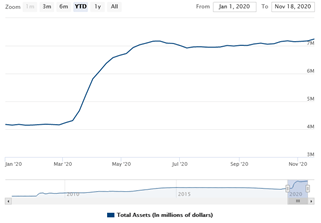
Fed Balance Sheet

Hot air, even in finance, rises. The Fed’s hot air caused the markets to abandon any notion of credit discrimination. Cruise lines and airlines borrowed billions. Every zombie with a working phone could get an investment bank to float its bonds.

Wolf Richter summarizes Mnuchin’s 12 reasons for pulling the plug here. Among the list of ostensible successes are the breathtaking volumes of junk and investment grade corporate bonds, municipal debt and asset backeds, issued since March. The cost of funding meanwhile became uncoupled from any reasonable credit fundamentals. Mnuchin notes that the spread on investment grade corporates has fallen from a peak of 4.06 percent to 1.40 percent, and on junk bonds from 10.78 percent to 4.94 percent.

So, the stated reason for pulling the plug is that jawboning worked, even if it was not backed up with actual purchases, and the SPVs have, according to Mnuchin, “clearly achieved their objective.”

That conclusion is only true if the programs were meant to completely undermine the process for sensible allocation of capital in our economy. The markets are not healthy. They are a farce. The government has been childishly reluctant to allow capitalism to work and to let untenable businesses go bankrupt so that resources can be invested productively. Investment-grade companies borrowing at under 2 percent and junk companies at under 4 percent is not a sign of victory. It is a disaster. If markets ever “normalize” and credit risk once again becomes a factor, the amount of refinancings required by the walking dead will probably require – yup – more government intervention to keep the junk windows open.

Bear in mind, this farce is mainly a bonanza for the economy’s dead weight. Normal financing is available for viable companies. As Mnuchin wrote on Thursday, “Banks have the lending capacity to meet the borrowing needs of their corporate, municipal and nonprofit clients.” The volume of commercial and industrial lending is down, mainly due to weaker demand, according the to Fed’s most recent survey of bank loan officers. But banks are still reasonably well capitalized and able to lend.

So Mnuchin’s move is a welcome one, even if it only keeps the Fed from throwing more gasoline on the credit market conflagration. Best outcome for the economy? The credit markets really freak out this week, bond prices drop like stones and borrowing rates rise to reasonable levels. That would be bloody, but necessary. If it happens, and the markets start to howl, the Greenspan Putters at the Fed will be revving their helicopters. Here’s hoping that Mnuchin keeps his nerve.

Price Discovery a Key Hurdle to Renewed CRE Lending

Commercial real estate companies are facing unprecedented challenges during the Covid-19 pandemic as they attempt to raise financing for new and ongoing projects. Tighter bank lending standards and widespread problems in the commercial mortgage-backed securities market are immediate issues. But CRE debt markets will not stage a significant comeback until assets start changing hands so that price discovery recovers, giving lenders the benchmarks they need to estimate LTVs and risk.

The lack of useful pricing data is reflected in the Green Street Commercial Property Price Index, which showed CRE asset price declines of between 5 and 25 percent in March and April, but which did not move notably between then and August because of the lack of transactions.

“The transaction market is quiet these days—and properties that are trading are ones relatively unaffected by the pandemic—so it’s tough to say with certainty how much pricing of some property types has changed,” said Peter Rothemund, Managing Director at Green Street Advisors. “But it’s pretty clear that the range of outcomes is going to be wide. Record-low interest rates mean properties with a stable top-line outlook will hold up well. Those with some risk, say multitenant office, probably see something like a 10% hit on average. And those with a lot of hair, like lodging and some retail, lose even more.”

Office projects in urban areas are expected to be particularly hard hit. Data from Kastle Systems, which manages employee tracking systems for over 41,000 companies in 47 states, shows that New York City office occupancy is now only 11.7 percent, and Kastle’s 10-city average languishes at 23.3 percent.

The hospitality and retail sectors are equally troubled. Fifty-four percent of CMBS loans transferred to special servicing entities due to delinquencies since March are backed by hotels, according to ratings firm Fitch. Another 32 percent are backed by retail properties, including malls.

Banks have responded to the CRE meltdown by becoming significantly more conservative. In the second quarter, two-thirds of banks surveyed by the Federal Reserve tightened standards for CRE loans. The remainder left them unchanged. Over a third made their lending standards tighter than at any time in the last 15 years.

The CMBS market, meanwhile, is being roiled by near-defaults, avoiding outright ones through special servicing, extend-to-pretend refinancings (also a favorite tool of banks for the CRE mortgage assets they retain), and forbearance measures. According to Fitch, $35.5 billion of U.S. CMBS was pushed into special servicing in the second quarter, up from $4.6 billion in the first. That’s up from a total of $9.1 billion at year-end 2019. The first half total represents 7 percent of the entire CMBS market.

Even with these discouraging signs, pressure is growing to get the CRE financing markets rolling again. As Ethan Penner of Mosaic Real Estate Partners recently told the Financial Times Odd Lots podcast, asset managers are piling up uninvested cash that they sorely want to put to work in order to be able to charge fees. Penner, credited with inventing the CMBS market in the early 1990s, cautioned that government policies like forbearance and the Fed’s ZIRP subsidy for refinancings reduce the pressure on owners of troubled assets to sell. This deprives the market of the data points it needs to establish prices on comparable assets. Without those, banks cannot feel confident generating LTVs and risk assessments, and asset managers will continue to fear buying assets for more than they are worth.

Uh Oh: Banks Turning to “Mark to Myth” Accounting for Massive CLO Market

Dominoes are falling in the financial sector according to the pattern set in 2008. Only then it was mortgages driving the mayhem. Now it is zombie corporate credits, kept alive for years on cheap junk-rated loans bundled into collateralized loan obligations (CLOs), which investors were forced to buy because central banks kept returns on everything else artificially low. 

Once the belle of the ball, since the Covid-19 crisis there are evidently too few buyers to provide prices for the banks that peddled the CLOs to value them accurately. According to a piece today in Risk, German lender Commerzbank is in trouble, having been forced to categorize $5.2 billion of its CLOs as Level 3 assets in the first quarter,  meaning they are unable to be marked to market (valued using market prices) and requiring Commerz to use a “mark to model” approach.

That means it more or less makes educated guesses, none of which anyone else believes. In 2008, this was referred to as “mark to myth” accounting when applied to the toxic mortgage securities that torpedoed many banks and brought down Lehman Brothers.

According to the FT, which wondered aloud today if CLOs were “ground zero” for the next stage of the financial crisis, JP Morgan estimates that US CLOs alone totaled some $691 billion at the end of last year, double the amount from two years earlier. In the same time, the market for the junk loans backing the CLOs doubled to $1.2 trillion.

The FT article showed that the Covid-19 crisis has since sent investors fleeing: Yields (which move inversely to prices) on the junkiest BB tranches shot up from around 9 percent to over 16 percent when the crisis hit.

All the investors stuck with this dreck can’t sell it without big losses, meaning they’ll have to sell more liquid assets to meet redemptions, spreading the misery to other markets, if the events of 2008 are any guide. But hey, perhaps the Fed and its counterparts will snap them all up, leaving the banks to repeat their mistakes yet again, and setting the stage for the next crisis. Third time’s a charm.

hen structured credit markets froze up in March, Commerzbank could not find enough real quotes to accurately price its collateralised loan obligations (CLOs). The dearth forced it to shift €4.8 billion worth ($5.2 billion) into the mark-to-model category –reserved for complex, illiquid assets

When structured credit markets froze up in March, Commerzbank could not find enough real quotes to accurately price its collateralised loan obligations (CLOs). The dearth forced it to shift €4.8 billion worth ($5.2 billion) into the mark-to-model category –reserved for complex, illiquid assets.The move increased the German lender’s stock of Level 3 assets by 69% quarter-on-quarter to €9.8 billion. As of end-March, they made up 7.2% of all fair value assets, up from 5% at end-2019.

hen structured credit markets froze up in March, Commerzbank could not find enough real quotes to accurately price its collateralised loan obligations (CLOs). The dearth forced it to shift €4.8 billion worth ($5.2 billion) into the mark-to-model category –reserved for complex, illiquid assets

Credit is the Emerging Bogeyman for Debt Dystopia

The downgrades of Macy’s and Kraft Heinz hint that the next corporate debt catastrophe might not be caused by a wall, but a cliff. The Wall of Maturities that so worried leveraged loan, junk bond and CMBS investors at various times after the Global Financial Crisis turned out to be easily vaulted. The real problem, according to an OECD report out today, might be the massive amount of debt clinging to the bottom rung of investment grade. Macy’s and Kraft Heinz lost their footing. If others follow, things could get interesting.

Wall Worriers were concerned that the junk bond and loan markets would not be able to absorb the massive amounts of debt that had to be refinanced from around 2012 through 2014 – much of it loans used to finance the pre-crisis buyout boom. The CMBS reckoning was thought to be coming a few years later.

But the Fed, ECB and other central banks came to the rescue. By driving down yields on moderate- and low-risk investments, they forced pretty much everyone to slide down the credit spectrum in search of yield. Junk issuers found plenty of indiscriminate demand, the brains on which zombie companies feed.

The OECD report highlights another big problem, and one that central banks will not be able to solve. This is simply that the flood of nonfinancial corporate bonds – some $2.1 trillion was issued in the wake of the Fed’s dovish turn in 2019 alone – is near junk. “Just over half (51%) of all new investment grade bonds in 2019 were rated BBB, the lowest investment-grade rating,” the report states. This is even more dismal that before the financial crisis, when only 39% of investment grade issues were rated BBB.

The proportion of junk bonds has also increased, to 25% of nonfinancial corporate issuance last year, and over 20% since 2010. That’s the longest period of high volumes of low-quality issuance since 1980, and, the OECD says, “indicates that default rates in a future downturn will likely be higher than in previous credit cycles.”

If more economic stalwarts like Macy’s start to circle the drain, or the coronavirus so messes up supply chains and distribution lines that many marginally investment-grade companies run into trouble, large numbers of issuers could cross the line into junk status, forcing investors who cannot hold high yield instruments to sell. Large-scale forced selling of distressed assets – that has an unpleasant ring to it.