Mnuchin is Right: the Fed’s Zombie Feast Must End

It seems counterintuitive to shut emergency financial market support programs in the middle of a pandemic and recession. But Treasury boss Steve Mnuchin’s move to force (there’s no other word for it) the Federal Reserve to let its most underused, and economically damaging, special purpose vehicles (SPVs) lapse as scheduled on December 31 is the right thing to do. Indeed, it should have been done sooner, before the programs prompted the most lamentable, economically distorting feeding frenzy for credit zombies and leveraged lenders the world has ever seen.

Mnuchin broke the news to Fed boss Jerome Powell on Thursday, sending markets fluttering. Financial reporters wrung their hands. The usually sensible FT moaned:

The move by Mr Mnuchin jeopardised a very effective partnership with Mr Powell that was crucial to securing a hefty US policy response to the coronavirus crisis early on. The central bank made no secret of the fact that it wanted to preserve the credit facilities being axed by the Treasury secretary as a key weapon in its arsenal to keep markets healthy during the pandemic.

Mnuchin notes that the five SPVs that Treasury wants to shut down (four others, which back short-term lending markets, will be renewed for another 90 days) succeeded. Oddly, they did so despite barely being used. The mere fact that the Fed said it would buy corporate bonds and bond ETFs juiced the lending markets to the point where they shoveled money at even the dodgiest credits. Not bad for jawboning. The Fed bought about $25 billion of securities under the programs (which had a total capacity of $2 trillion). This is a rounding error compared with the other QE programs that have swelled the Fed’s balance sheet to over $7 trillion.
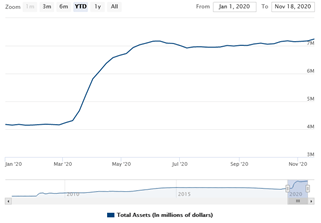
Fed Balance Sheet

Hot air, even in finance, rises. The Fed’s hot air caused the markets to abandon any notion of credit discrimination. Cruise lines and airlines borrowed billions. Every zombie with a working phone could get an investment bank to float its bonds.

Wolf Richter summarizes Mnuchin’s 12 reasons for pulling the plug here. Among the list of ostensible successes are the breathtaking volumes of junk and investment grade corporate bonds, municipal debt and asset backeds, issued since March. The cost of funding meanwhile became uncoupled from any reasonable credit fundamentals. Mnuchin notes that the spread on investment grade corporates has fallen from a peak of 4.06 percent to 1.40 percent, and on junk bonds from 10.78 percent to 4.94 percent.

So, the stated reason for pulling the plug is that jawboning worked, even if it was not backed up with actual purchases, and the SPVs have, according to Mnuchin, “clearly achieved their objective.”

That conclusion is only true if the programs were meant to completely undermine the process for sensible allocation of capital in our economy. The markets are not healthy. They are a farce. The government has been childishly reluctant to allow capitalism to work and to let untenable businesses go bankrupt so that resources can be invested productively. Investment-grade companies borrowing at under 2 percent and junk companies at under 4 percent is not a sign of victory. It is a disaster. If markets ever “normalize” and credit risk once again becomes a factor, the amount of refinancings required by the walking dead will probably require – yup – more government intervention to keep the junk windows open.

Bear in mind, this farce is mainly a bonanza for the economy’s dead weight. Normal financing is available for viable companies. As Mnuchin wrote on Thursday, “Banks have the lending capacity to meet the borrowing needs of their corporate, municipal and nonprofit clients.” The volume of commercial and industrial lending is down, mainly due to weaker demand, according the to Fed’s most recent survey of bank loan officers. But banks are still reasonably well capitalized and able to lend.

So Mnuchin’s move is a welcome one, even if it only keeps the Fed from throwing more gasoline on the credit market conflagration. Best outcome for the economy? The credit markets really freak out this week, bond prices drop like stones and borrowing rates rise to reasonable levels. That would be bloody, but necessary. If it happens, and the markets start to howl, the Greenspan Putters at the Fed will be revving their helicopters. Here’s hoping that Mnuchin keeps his nerve.

Price Discovery a Key Hurdle to Renewed CRE Lending

Commercial real estate companies are facing unprecedented challenges during the Covid-19 pandemic as they attempt to raise financing for new and ongoing projects. Tighter bank lending standards and widespread problems in the commercial mortgage-backed securities market are immediate issues. But CRE debt markets will not stage a significant comeback until assets start changing hands so that price discovery recovers, giving lenders the benchmarks they need to estimate LTVs and risk.

The lack of useful pricing data is reflected in the Green Street Commercial Property Price Index, which showed CRE asset price declines of between 5 and 25 percent in March and April, but which did not move notably between then and August because of the lack of transactions.

“The transaction market is quiet these days—and properties that are trading are ones relatively unaffected by the pandemic—so it’s tough to say with certainty how much pricing of some property types has changed,” said Peter Rothemund, Managing Director at Green Street Advisors. “But it’s pretty clear that the range of outcomes is going to be wide. Record-low interest rates mean properties with a stable top-line outlook will hold up well. Those with some risk, say multitenant office, probably see something like a 10% hit on average. And those with a lot of hair, like lodging and some retail, lose even more.”

Office projects in urban areas are expected to be particularly hard hit. Data from Kastle Systems, which manages employee tracking systems for over 41,000 companies in 47 states, shows that New York City office occupancy is now only 11.7 percent, and Kastle’s 10-city average languishes at 23.3 percent.

The hospitality and retail sectors are equally troubled. Fifty-four percent of CMBS loans transferred to special servicing entities due to delinquencies since March are backed by hotels, according to ratings firm Fitch. Another 32 percent are backed by retail properties, including malls.

Banks have responded to the CRE meltdown by becoming significantly more conservative. In the second quarter, two-thirds of banks surveyed by the Federal Reserve tightened standards for CRE loans. The remainder left them unchanged. Over a third made their lending standards tighter than at any time in the last 15 years.

The CMBS market, meanwhile, is being roiled by near-defaults, avoiding outright ones through special servicing, extend-to-pretend refinancings (also a favorite tool of banks for the CRE mortgage assets they retain), and forbearance measures. According to Fitch, $35.5 billion of U.S. CMBS was pushed into special servicing in the second quarter, up from $4.6 billion in the first. That’s up from a total of $9.1 billion at year-end 2019. The first half total represents 7 percent of the entire CMBS market.

Even with these discouraging signs, pressure is growing to get the CRE financing markets rolling again. As Ethan Penner of Mosaic Real Estate Partners recently told the Financial Times Odd Lots podcast, asset managers are piling up uninvested cash that they sorely want to put to work in order to be able to charge fees. Penner, credited with inventing the CMBS market in the early 1990s, cautioned that government policies like forbearance and the Fed’s ZIRP subsidy for refinancings reduce the pressure on owners of troubled assets to sell. This deprives the market of the data points it needs to establish prices on comparable assets. Without those, banks cannot feel confident generating LTVs and risk assessments, and asset managers will continue to fear buying assets for more than they are worth.

Uh Oh: Banks Turning to “Mark to Myth” Accounting for Massive CLO Market

Dominoes are falling in the financial sector according to the pattern set in 2008. Only then it was mortgages driving the mayhem. Now it is zombie corporate credits, kept alive for years on cheap junk-rated loans bundled into collateralized loan obligations (CLOs), which investors were forced to buy because central banks kept returns on everything else artificially low. 

Once the belle of the ball, since the Covid-19 crisis there are evidently too few buyers to provide prices for the banks that peddled the CLOs to value them accurately. According to a piece today in Risk, German lender Commerzbank is in trouble, having been forced to categorize $5.2 billion of its CLOs as Level 3 assets in the first quarter,  meaning they are unable to be marked to market (valued using market prices) and requiring Commerz to use a “mark to model” approach.

That means it more or less makes educated guesses, none of which anyone else believes. In 2008, this was referred to as “mark to myth” accounting when applied to the toxic mortgage securities that torpedoed many banks and brought down Lehman Brothers.

According to the FT, which wondered aloud today if CLOs were “ground zero” for the next stage of the financial crisis, JP Morgan estimates that US CLOs alone totaled some $691 billion at the end of last year, double the amount from two years earlier. In the same time, the market for the junk loans backing the CLOs doubled to $1.2 trillion.

The FT article showed that the Covid-19 crisis has since sent investors fleeing: Yields (which move inversely to prices) on the junkiest BB tranches shot up from around 9 percent to over 16 percent when the crisis hit.

All the investors stuck with this dreck can’t sell it without big losses, meaning they’ll have to sell more liquid assets to meet redemptions, spreading the misery to other markets, if the events of 2008 are any guide. But hey, perhaps the Fed and its counterparts will snap them all up, leaving the banks to repeat their mistakes yet again, and setting the stage for the next crisis. Third time’s a charm.

hen structured credit markets froze up in March, Commerzbank could not find enough real quotes to accurately price its collateralised loan obligations (CLOs). The dearth forced it to shift €4.8 billion worth ($5.2 billion) into the mark-to-model category –reserved for complex, illiquid assets

When structured credit markets froze up in March, Commerzbank could not find enough real quotes to accurately price its collateralised loan obligations (CLOs). The dearth forced it to shift €4.8 billion worth ($5.2 billion) into the mark-to-model category –reserved for complex, illiquid assets.The move increased the German lender’s stock of Level 3 assets by 69% quarter-on-quarter to €9.8 billion. As of end-March, they made up 7.2% of all fair value assets, up from 5% at end-2019.

hen structured credit markets froze up in March, Commerzbank could not find enough real quotes to accurately price its collateralised loan obligations (CLOs). The dearth forced it to shift €4.8 billion worth ($5.2 billion) into the mark-to-model category –reserved for complex, illiquid assets

Fed Brings Knife to Gunfight

The Fed is not only no longer a credible player, it’s actually causing measurable harm. Investors, hoping for something useful to come out of the G-7 conference call this morning, reacted to the central bank’s 50 basis point rate cut by driving the Dow and S&P down 3.5 percent by early afternoon. It would have been wiser for Powell and Friends to keep silent, sequestering their dwindling monetary ammunition for another day, when it might have done some good.

Even stock market investors understand that the Fed is making a category error. The Fed boss may have a hammer, but this crisis isn’t a nail. Specifically, unlike the Global Financial Crisis, when rate cuts helped ease pressure on bank balance sheets, Wall Street just isn’t the problem this time around. The industry’s solipsism makes it hard for bankers, and by extension, the Fed, to understand this. But this time, the trouble stems from events outside their purview. As Wolf Richter put it in a post earlier today, “Disappointed the Fed didn’t print antibodies?”

Worse, the Fed’s move could contribute to trouble in bank-land. In a note out yesterday, Fitch analysts warned that a rate cut could hurt bank profitability. With historic levels of marginal investment-grade debt about to slide off the cliff, and the leveraged markets looking increasingly parlous, banks don’t need this kind of trouble:

Fitch sees near-term downside to profitability due to asset yield compression while the yield curve falls at a historical pace, with the 30-year rate hitting an all-time low, as the Fed indicated that it would use necessary tools to support the economy. While we expect that banks will attempt to be quick in their response to cut deposit and other funding costs accordingly, these actions will not likely be to the same degree that asset yields compress, resulting in lower margins and reducing overall profitability, at least in the near term. Fitch notes the 30-day LIBOR forward curve dropped 25 bps during February, which could significantly affect loan yields during 1Q20.

That’s not apocalyptic, but it’s not great news, either, especially as the biggest US bank dealers – the eight so-called systemically important ones – boosted their equity holdings by 20 percent last year, to $454.5 billion, according to Risk. Luckily, they increased their stock of Treasuries by 28 percent, to $345.4 billion. The latter are rallying.

It is almost a relief to see the Fed out of the game, like a tennis star who has missed an easy volley staring dumbly at his racket, looking for the hole. The invective spewed at the Fed by Trump and his Tammany-on-the-Potamac enablers was dispiriting before; now it is a policy-ossifying distraction. On to the next bad option.

Of Falling Knives and Vicious Circles: Will the Corona Crisis Spread Like the 2008 Crash?

Catching a falling knife? Check. Rushing the exits? Yup. Vicious circle? Yeah, that one too. Market clichés last heard during the 2008 Financial Crisis are back in vogue among the financial commentariat. But there are important differences between that disaster and the market meltdown unfolding this week. It’s unlikely the Corona Crisis will metastasize in the same way.

The 2008 crisis had several novel characteristics. A significant driver was incorrect risk management assumptions about the correlations among assets. When mortgages proved to be more correlated than models assumed, mortgage-backed securities bombed. More broadly, entire bank business models based on the assumption that diversification was an unchallengeable law became fountains of red ink when different types of assets began declining in lockstep.

Two related factors meant to improve risk management ended up acting as vectors of contagion, turning a housing problem into a disaster for the bond and equity markets, too. The first were regulatory capital rules, which require banks to set aside more capital against high-risk assets than they set aside against safer ones. The second factor is the market practice of requiring a firm to stump up more collateral when a trading position declines in value.

These all sound sensible. But if the assets becoming riskier (mortgage-backed bonds in 2008) cannot be sold easily, banks have to get the money to pay their capital and collateral requirements by selling other types of assets, like stocks, Treasuries and corporate bonds. Banks started pouring these assets into the markets in 2008, driving down prices on the securities, some of which they retained in their portfolios, triggering the need for yet more capital and collateral, and so on – the archetypical vicious circle.

As these assets fell in price, potential buyers stepped back, not wanting (as the pundits put it) to try to catch a falling knife. So prices of all types of assets plunged further. The result was the worst multi-asset market meltdown since the Great Depression.

The Corona Calamity looks different, so far. If it does become an undifferentiating multi-asset meltdown, it will be because the coronavirus wreaks terrible havoc on the world’s economies, and not because of the types of unanticipated structural links that spread woe in 2008.

There are some positive signs. The negative correlation among asset classes, described by old wives as not keeping all your eggs in the same basket, and finance professors as diversification, appears to be back. The Fed’s abuse of savers through ultra-low rates forced investors to take more risk in the equity markets than they really wanted. Now that stock prices are dropping, “safe haven” assets like Treasuries are in demand. Stocks go down, Treasuries go up – just like the textbooks say should happen.

Regulatory capital rules are still problematic, forcing banks to pony up capital at what appears to be just the wrong times – when the value of their assets are falling. But the Dodd Frank and Basel Committee rules implemented since the Financial Crisis boosted the core capital requirements, so firms are better capitalized from the start. That should give them a bigger margin of error and reduce the chance of igniting a (sorry) run for the exits. And, assuming the Fed’s brain trust doesn’t gut the Volcker Rule, banks are barred from dabbling in ultra-risky proprietary trading, which should help to keep collateral calls to a manageable level.

This means the Corona Crisis could remain an equities problem. Sure, corporations could fail due to supply chain disruptions or falling sales, and so bond investors could take a bath on the squillions they have invested in junk and marginal investment-grade securities. Banks, meanwhile, might have a lot of senior loan write-offs in their future. But equities aren’t principally held by banks, so the regulatory capital and collateral issues should not act as vectors of contagion the way they did during the Financial Crisis.

The Financial Crisis was so pernicious, in part, because it was accelerated and magnified by structural and modeling issues that had never been tested – new product technologies, newish regulatory capital rules, new risk management models. The current meltdown appears to be a refreshingly straightforward catastrophe, with an obvious exogenous trigger and reasonably straight causal lines to be drawn from independent to dependent variables. But I vaguely remember thinking that in early 2008, too….

Volcker Rollback is a Camel’s Nose Under the Wrong Tent Flap

It all seems reasonable. New rules from the Fed, OCC and FDIC would only tweak technical bits of the Volcker Rule to ease bank business interactions with hedge funds and private equity. What’s wrong with that? After all, the 3 percent limit on direct ownership of these funds remains in place, ostensibly keeping banks from running amok and reviving the risky proprietary trading businesses that the rule, part of the Dodd Frank reforms passed in response to the Global Financial Crisis, effectively quashed. Banks and regulators portray the measure, out for public comment until April 1, as an exercise in fine tuning, rather than a strategic change.

That might be the case. But the rule change, along with other mods to compliance regulations related to prop trading made last summer, reflect how financial regulation is subject to its own version of the second law of thermodynamics. The regulatory trend is always toward entropy. And this is troubling.

Many at the time of its passage thought the Volcker Rule was downright draconian, separating banks from one of their core revenue-generating businesses. Hotshot traders left investment banks in droves in order to set up their own hedge funds, only to step into a decade-long performance abyss for active managers, where buying a dirt-cheap index-tracking ETF was almost always a better bet than paying 2 and 20 to some guy in red suspenders who never beat the market. The archetypical alpha chaser struggled along like a fat man running after beta’s bus.

That’s still the case. So why worry? Well, to its boosters, myself included, the Volcker Rule seemed like a step toward what the financial system really needed, which was (and is) a new Glass-Steagall Act separating banking and speculative investment businesses. When Sandy Weill convinced Bill Clinton to withdraw the Act in 1999, so the former could stitch together his shambolic Frankenstein’s monster, Citigroup, it was one step on the path toward the Financial Crisis.

During the crisis, the big commercial/investment bank hybrids essentially held their massive retail deposits hostage, forcing the government to bail them out when their “financial engineering” products started blowing up in their faces. The Volcker Rule was meant to keep banks from dabbling in novel, high-risk, nontransparent investment strategies in order to avoid this happening again.

But the banks and investment banks are still joined at the hip. In some cases, even more so. Goldman Sachs is getting into retail. Morgan Stanley is buying E Trade – admittedly, not FDIC-insured, but with over $300 billion in mostly retail assets, something the government is going to be watching closely. And there’s always Citi, with its unerring talent for stepping on every possible land mine.

Even Fitch, which did not exactly cover itself with glory during the run-up to the Financial Crisis, wrote an admirably canary-in-the-coalmine report today saying that the changes were “indicative of loosening regulation and recalibration of post-crisis regulatory rules.” The rating firm “views robust regulation and capital requirements as supportive of credit ratings; therefore relaxation would be viewed as a credit negative.”

It would be more encouraging to see bank regulators laboring to build a more robust wall between taxpayer-insured businesses and the hedge fund and private equity casinos. This mod represents a step – granted, a baby step – in the wrong direction.