It seems counterintuitive to shut emergency financial market support programs in the middle of a pandemic and recession. But Treasury boss Steve Mnuchin’s move to force (there’s no other word for it) the Federal Reserve to let its most underused, and economically damaging, special purpose vehicles (SPVs) lapse as scheduled on December 31 is the right thing to do. Indeed, it should have been done sooner, before the programs prompted the most lamentable, economically distorting feeding frenzy for credit zombies and leveraged lenders the world has ever seen.
Mnuchin broke the news to Fed boss Jerome Powell on Thursday, sending markets fluttering. Financial reporters wrung their hands. The usually sensible FT moaned:
The move by Mr Mnuchin jeopardised a very effective partnership with Mr Powell that was crucial to securing a hefty US policy response to the coronavirus crisis early on. The central bank made no secret of the fact that it wanted to preserve the credit facilities being axed by the Treasury secretary as a key weapon in its arsenal to keep markets healthy during the pandemic.
Mnuchin notes that the five SPVs that Treasury wants to shut down (four others, which back short-term lending markets, will be renewed for another 90 days) succeeded. Oddly, they did so despite barely being used. The mere fact that the Fed said it would buy corporate bonds and bond ETFs juiced the lending markets to the point where they shoveled money at even the dodgiest credits. Not bad for jawboning. The Fed bought about $25 billion of securities under the programs (which had a total capacity of $2 trillion). This is a rounding error compared with the other QE programs that have swelled the Fed’s balance sheet to over $7 trillion.
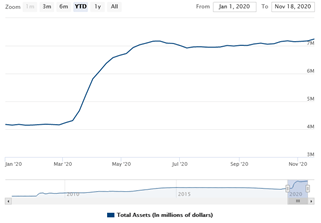
Hot air, even in finance, rises. The Fed’s hot air caused the markets to abandon any notion of credit discrimination. Cruise lines and airlines borrowed billions. Every zombie with a working phone could get an investment bank to float its bonds.
Wolf Richter summarizes Mnuchin’s 12 reasons for pulling the plug here. Among the list of ostensible successes are the breathtaking volumes of junk and investment grade corporate bonds, municipal debt and asset backeds, issued since March. The cost of funding meanwhile became uncoupled from any reasonable credit fundamentals. Mnuchin notes that the spread on investment grade corporates has fallen from a peak of 4.06 percent to 1.40 percent, and on junk bonds from 10.78 percent to 4.94 percent.
So, the stated reason for pulling the plug is that jawboning worked, even if it was not backed up with actual purchases, and the SPVs have, according to Mnuchin, “clearly achieved their objective.”
That conclusion is only true if the programs were meant to completely undermine the process for sensible allocation of capital in our economy. The markets are not healthy. They are a farce. The government has been childishly reluctant to allow capitalism to work and to let untenable businesses go bankrupt so that resources can be invested productively. Investment-grade companies borrowing at under 2 percent and junk companies at under 4 percent is not a sign of victory. It is a disaster. If markets ever “normalize” and credit risk once again becomes a factor, the amount of refinancings required by the walking dead will probably require – yup – more government intervention to keep the junk windows open.
Bear in mind, this farce is mainly a bonanza for the economy’s dead weight. Normal financing is available for viable companies. As Mnuchin wrote on Thursday, “Banks have the lending capacity to meet the borrowing needs of their corporate, municipal and nonprofit clients.” The volume of commercial and industrial lending is down, mainly due to weaker demand, according the to Fed’s most recent survey of bank loan officers. But banks are still reasonably well capitalized and able to lend.
So Mnuchin’s move is a welcome one, even if it only keeps the Fed from throwing more gasoline on the credit market conflagration. Best outcome for the economy? The credit markets really freak out this week, bond prices drop like stones and borrowing rates rise to reasonable levels. That would be bloody, but necessary. If it happens, and the markets start to howl, the Greenspan Putters at the Fed will be revving their helicopters. Here’s hoping that Mnuchin keeps his nerve.
 Cass Materialism